The Contract Player ~ Chapter Six
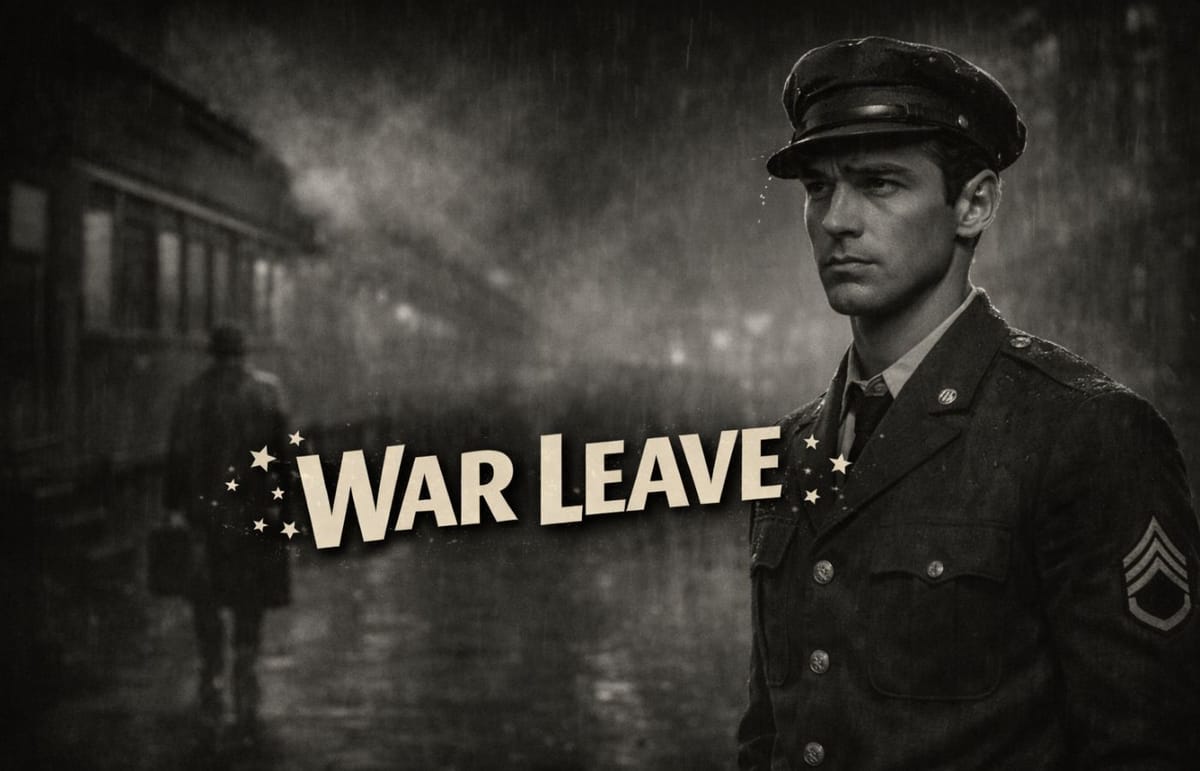
War Leave
The Velvet Backlot
Hollywood, 1943.
Behind the glamour, contracts bind tighter than desire. Careers are constructed. Reputations are managed. And men learn quickly what parts of themselves must remain unseen.
The Velvet Backlot is a queer historical erotic series set inside the Golden Age studio system, where love exists in shadow and survival depends on performance.
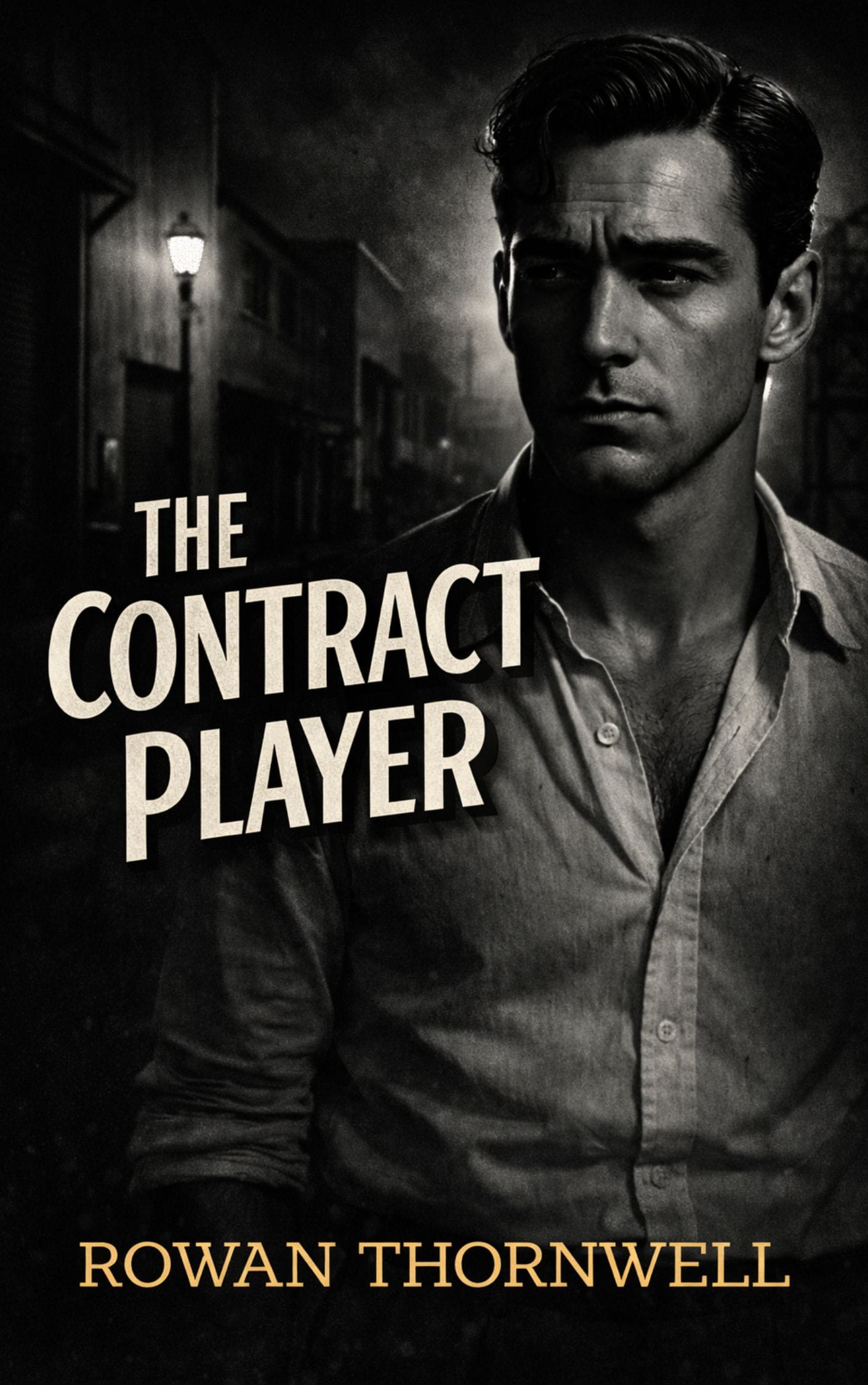
The first novel, The Contract Player, follows rising actor Julian Cross and the man assigned to control him. What begins as supervision becomes proximity. What becomes proximity turns into something far more dangerous.
Desire is rationed.
Consent is negotiated.
And every choice leaves a mark.
Need to catch up?
Read the beginning chapters here...
The Contract Player Chapters 1 - 5
War Leave
Chapter Six
The war had seemed distant until it wasn't. By December of 1943, Los Angeles had transformed into a city of temporary men, soldiers flooding in on brief leave before shipping out to the Pacific, sailors on shore leave from San Diego, airmen from the desert training bases. They filled the streets in uniform, hungry for pleasure, desperate for oblivion, carrying the weight of mortality like a second skin.
The studio threw a party for them. Or rather, arranged for several actors to attend a party at a private residence in the hills, good publicity, good morale, proof that Hollywood supported the war effort. Julian received his invitation via Mora, delivered with typical efficiency and a list of behavioural guidelines.
"You'll be photographed arriving," Mora said, reviewing the instructions in Julian's apartment. "Smile, shake hands, thank them for their service. Stay two hours minimum, three maximum. Don't get drunk. Don't get into political discussions. Don't—"
"Let me guess," Julian interrupted. "Don't do anything that could be misconstrued."
Mora's eyes flicked up from his notes. "Don't be reckless. These men are facing death. That makes them volatile. Unpredictable. More dangerous than the usual crowds you navigate."
"Dangerous how?"
"Emotionally raw. Physically aggressive. Likely to push boundaries, test limits, do things they wouldn't do if they thought they had a future to protect." Mora closed his notebook. "I'll be there. Not with you, but present. If anything feels unsafe, find me immediately."
"You're always there, aren't you?" Julian said it without rancour, just observation.
"Yes. That's the job."
The house was in the Hollywood Hills, sprawling and modern, all glass and white walls overlooking the city. By the time Julian arrived at nine, the party was already loud, music from a phonograph, voices raised in laughter and argument, the distinctive energy of men trying to forget what waited for them across an ocean.
Uniforms everywhere. Army khaki, Navy dress blues, Marines in their distinctive green. Young faces, most of them, farm boys and city kids transformed into soldiers, holding cocktails and cigarettes with hands that would soon hold rifles. Among them, a handful of actors and starlets, strategically distributed to provide glamour and distraction.
Julian moved through the crowd, shaking hands, accepting thanks that felt unearned. What had he done to deserve gratitude? Made movies while these men prepared to die?
"You're Julian Cross," a Marine said, gripping his hand too hard. He was perhaps twenty, freckled, drunk. "I seen your picture. The one where you play the soldier."
"I'm glad you enjoyed it."
"Enjoyed it?" The Marine laughed, sharp and bitter. "You looked real clean for a soldier. Real pretty. Not like us when we come back from manoeuvres covered in mud and piss."
His friends pulled him away, apologizing. Julian smiled, said it was fine, moved on. But the encounter left him unsettled. The Marine was right, everything Julian did was pretend, surfaces without substance, performance without risk.
He found a corner near the windows and accepted a drink from a passing waiter. Whiskey, strong enough to burn. Below, Los Angeles spread out in a grid of lights, beautiful and false, a city built on manufactured dreams while the world tore itself apart.
"Hell of a view," someone said beside him.
Julian turned. The soldier was Army, a lieutenant based on the bars at his shoulder. Older than most of the others, maybe thirty, with dark eyes and a face that suggested Irish or Italian ancestry. Handsome in a rough way, with a boxer's broken nose and a scar through one eyebrow.
"It is," Julian agreed.
"You're one of the actors."
"Julian Cross."
"Tom Riley." They shook hands. Riley's grip was firm but not aggressive. "Sorry about Martinez earlier. The kid's shipping out Tuesday. He's scared shitless and covering it with anger."
"I understand."
"Do you?" Riley's tone wasn't accusatory, just curious. "No offense, but you look like you've never been scared a day in your life."
Julian laughed without humour. "I'm scared constantly. Just of different things."
Riley studied him for a moment, then nodded. "Fair enough. Fear's fear, I guess. Doesn't matter what triggers it."
They stood together in companionable silence, watching the party swirl around them. Riley sipped his drink, bourbon, from the smell, and loosened his tie slightly. There was something solid about him, unperformed. Real in a way the studio people never were.
"Where are you headed?" Julian asked. "After leave."
"Can't say specifically. Pacific theatre. Somewhere with too many mosquitoes and too much artillery." Riley's jaw tightened. "Could be three months, could be three years. Could be never coming back."
The bluntness was startling. Most people avoided such direct acknowledgment of mortality.
"Do you believe that? That you might not come back?"
"I try not to think about it. But yeah, some nights it's all I think about." Riley finished his bourbon, set the glass on a nearby table. "That's why we're all here, isn't it? Trying to forget for a few hours that we're probably going to die in some jungle or on some beach, our mothers getting telegrams saying we died bravely for our country."
Julian had no response adequate to that truth.
"Sorry," Riley said, shaking his head. "Shit, I'm being morbid. It's the whiskey. And the waiting. The waiting's worse than anything else."
"Don't apologize."
They talked for another twenty minutes, careful conversation that skirted around dangerous topics, finding safety in surface pleasantries. Riley had been a construction worker in Chicago before the war. He had two sisters, both married. He liked baseball and hated jazz. Simple facts that made him human, specific, real.
Julian found himself relaxing slightly, enjoying the conversation for its own sake rather than as performance. Riley wasn't looking at him like an actor or a commodity or a carefully constructed image. Just as another person trying to navigate an impossible situation.
"You want to get some air?" Riley asked eventually. "It's getting loud in here."
Julian glanced around. The party had grown more chaotic, voices louder, laughter more forced, the desperation more palpable. Several soldiers were dancing with starlets, hands wandering to places that would be scandalous in daylight but seemed permissible under the shadow of war.
"All right," Julian said.
They made their way through the crowd to a side door that opened onto a terrace. The night air was cool, carrying the scent of jasmine and cigarette smoke. A few other couples occupied the darker corners, their silhouettes suggesting activities more intimate than conversation.
Riley leaned against the railing, looking out at the city. "You ever think about enlisting?"
The question landed like an accusation, though Riley's tone remained neutral.
"I tried," Julian said, which was true. "They rejected me. Heart murmur."
"That real or studio fiction?"
"Real enough to keep me out of uniform."
Riley nodded slowly. "Probably for the best. You'd look terrible in khaki."
It might have been an insult or a compliment or simple observation. Julian couldn't tell.
"Can I ask you something?" Riley said, turning to face him directly.
"All right."
"You queer?"
The word hung in the air between them, dangerous and electric. Julian's throat went dry. Every instinct screamed at him to deny it, to laugh it off, to perform outrage or confusion. But something in Riley's eyes stopped him, not judgment, not malice. Just direct inquiry.
"Why do you ask?" Julian managed.
"Because I am," Riley said simply. "And I can usually tell. The way you stand, the way you looked at me when we shook hands. The way you're looking at me now." He paused. "If I'm wrong, say so and I'll drop it. But I don't think I'm wrong."
Julian's heart hammered against his ribs. This was exactly the situation Mora had warned him about, vulnerability, exposure, danger. He should walk away. He should find Mora immediately. He should deny everything and retreat to safety.
Instead, he said, "You're not wrong."
Riley exhaled, something like relief crossing his face. "Christ. I thought maybe I was losing my mind. Everyone here is so goddamn perfect and straight and proper. I was starting to think I imagined that people like us existed."
"We exist. We're just good at hiding."
"Clearly." Riley glanced back toward the party, then at Julian again. "Listen, I ship out in four days. I'll probably be dead by spring. And right now, standing here with you, I really don't want to spend what might be my last decent night in America making small talk about baseball and the weather."
Julian understood immediately what Riley was suggesting. The want in his eyes, the tension in his body, the desperate edge to his voice. This wasn't strategic or controlled or managed by Mora. This was raw need meeting raw need, mortality stripping away pretence.
"There are bedrooms," Riley continued quietly. "Upstairs. Half of them are already occupied but I saw at least two empty ones. We could—"
"I can't," Julian said, though his body was already betraying him, already responding to the invitation. "It's not safe. If someone saw, if anyone found out—"
"Who's going to find out? Everyone down here is drunk and distracted. We lock the door, we're quiet, we're careful. Twenty minutes, Cross. That's all I'm asking. Twenty minutes to feel something real before I go die for my country."
It was emotional manipulation and Julian knew it. But it was also true. Riley was shipping out, facing death, seeking human connection in whatever form he could find it. And Julian. Julian wanted this too, wanted it more than he'd wanted anything in months. Not the clinical arrangement Mora had provided but this: messy, dangerous, real.
"All right," Julian heard himself say. "But we have to be careful."
"I'm always careful," Riley said, and took his hand.
They slipped back inside separately, reuniting at the base of the stairs. Julian followed Riley up to the second floor, heart pounding, aware of every sound, every footstep, every voice that might signal discovery. Riley tried three doors before finding an unlocked bedroom, small, dark, a guest room with minimal furniture.
Riley locked the door, turned to face Julian. For a moment they just looked at each other, the reality of what they were about to do settling over them.
Then Riley crossed the space between them and kissed him.
It was nothing like kissing Catherine, nothing performed or calculated. This was hunger and desperation, Riley's mouth hot and urgent, his hands already working at Julian's jacket, his belt. Julian responded with equal urgency, pulling at Riley's uniform, buttons coming loose, fabric bunching and tearing slightly in their haste.
They fell onto the bed in a tangle of limbs and half-removed clothing. Riley's body was hard and solid, scarred from training and marked by recent violence, a healing burn on his shoulder, bruises across his ribs. Real damage on a real body, so different from the perfected flesh of actors and arranged encounters.
🖤 Subscribe to read The Contract Player in full.
Or purchase the complete novel directly from Rowan and own the story now.