The Contract Player ~ Chapter Three
The Handler's Rules

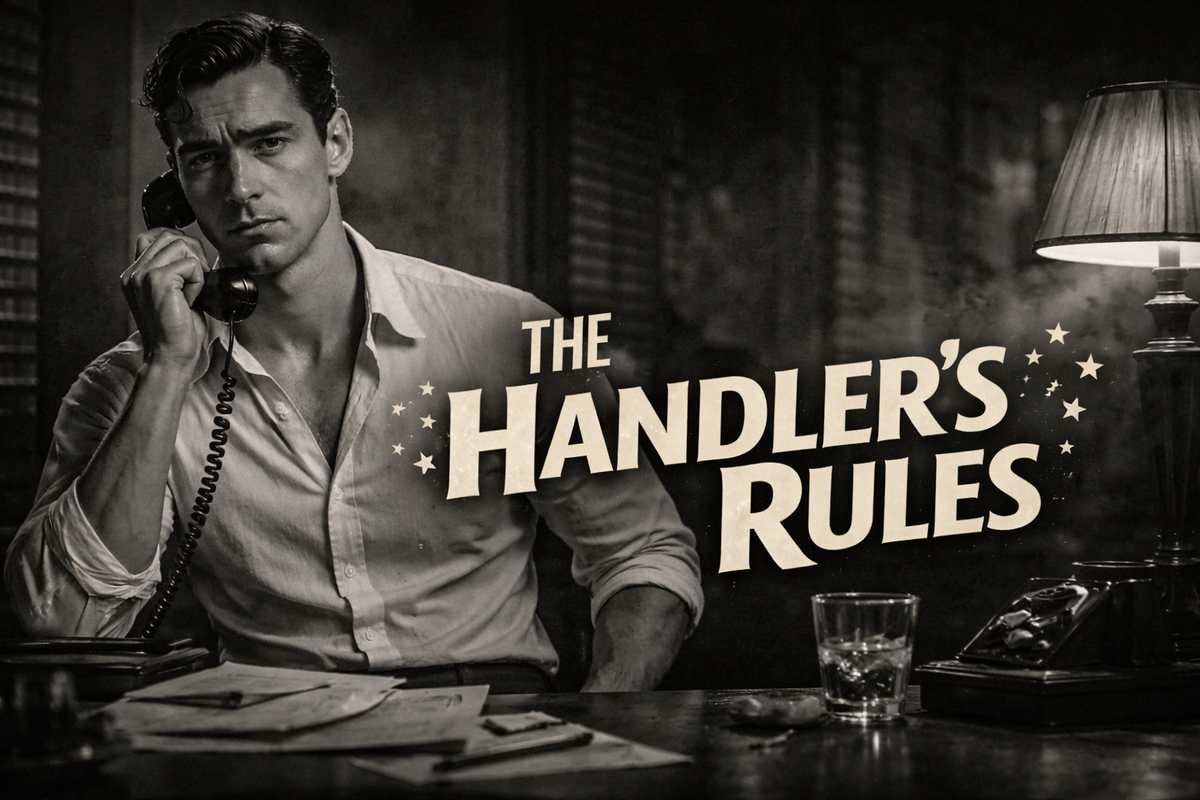
The Velvet Backlot
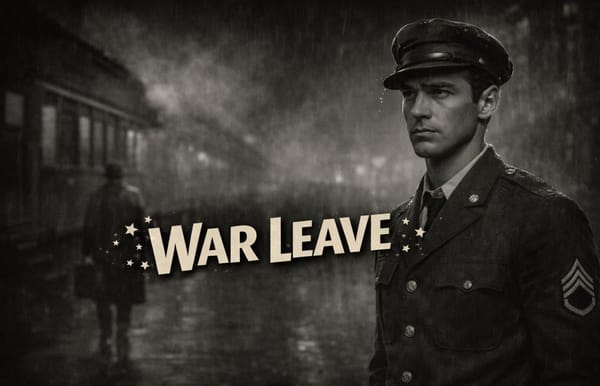
Hollywood, 1943.
Behind the glamour, contracts bind tighter than desire. Careers are constructed. Reputations are managed. And men learn quickly what parts of themselves must remain unseen.
The Velvet Backlot is a queer historical erotic series set inside the Golden Age studio system, where love exists in shadow and survival depends on performance.
The first novel, The Contract Player, follows rising actor Julian Cross and the man assigned to control him. What begins as supervision becomes proximity. What becomes proximity turns into something far more dangerous.
Desire is rationed.
Consent is negotiated.
And every choice leaves a mark.
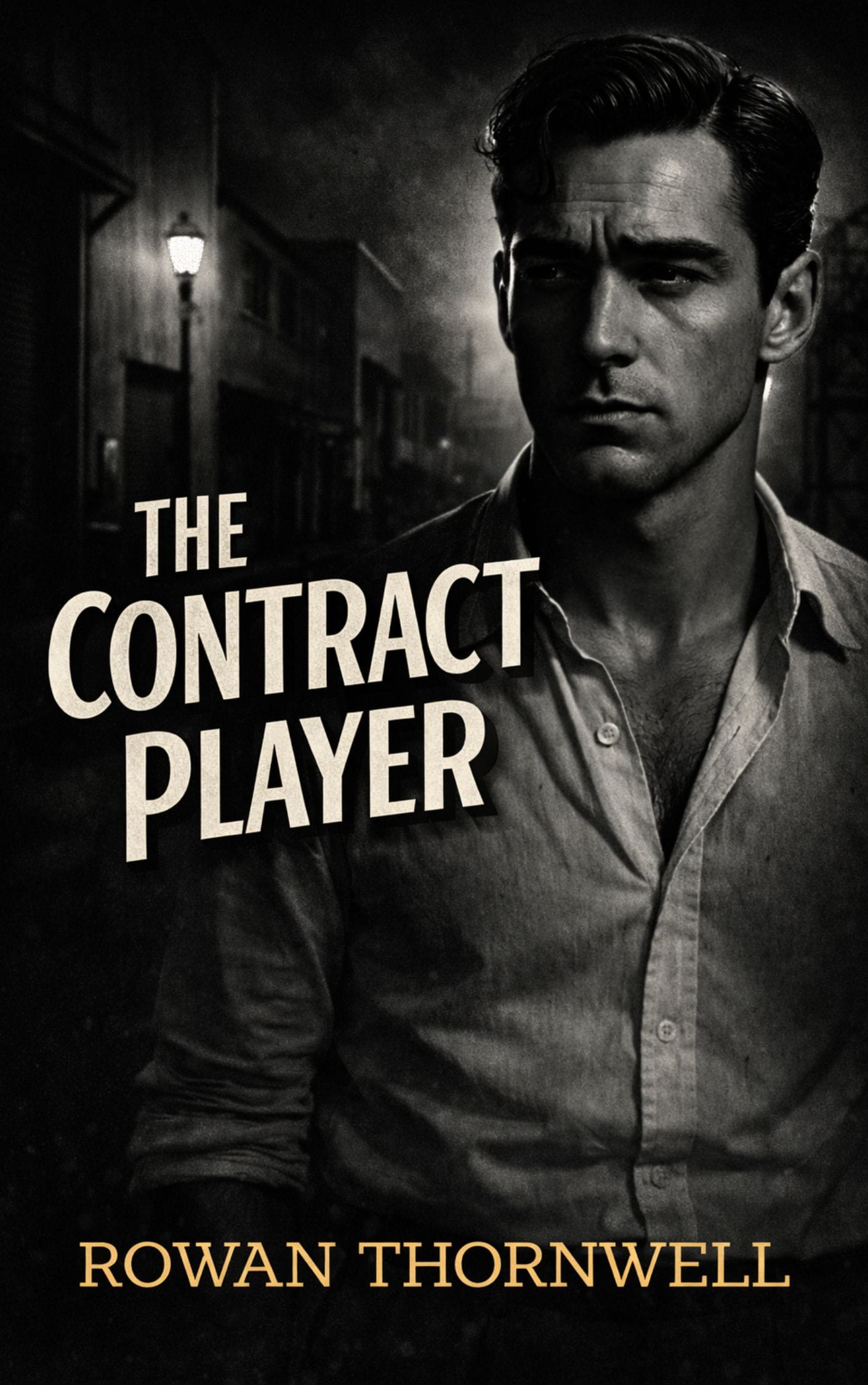
🖤 Subscribe to read The Contract Player in full.
Or purchase the complete novel directly from Rowan and own the story now.

Read Chapter One & Two Here...
 Rowan Thornwell
 Rowan Thornwell
The Handler's Rules
Chapter Three
The apartment in West Hollywood had crown moulding and hardwood floors that caught the morning light. Two rooms plus a kitchen, bathroom with a clawfoot tub, windows overlooking a quiet street lined with jacaranda trees. Furniture had appeared overnight. Sofa, bed, dining table, everything tasteful and impersonal as a hotel. On the kitchen counter, someone had left a bottle of milk, a loaf of bread, coffee in a tin.
Julian had spent his first night there lying awake on sheets that smelled of starch and strangers, listening to unfamiliar sounds through unfamiliar walls. Everything felt borrowed, temporary, as if he were living in a stage set that could be struck at any moment.
At eight forty-five, he dressed in one of his new suits, the charcoal one, and waited.
At precisely nine o'clock, a knock came at the door.
Daniel Mora stood in the hallway wearing the same dark suit as yesterday, or one identical to it. His expression was neutral, professional. He glanced past Julian into the apartment with a brief, assessing look.
"You slept poorly," he observed.
It wasn't a question.
"How do you know?"
"Your collar's crooked. You missed a spot shaving. You've had coffee but no food." Mora's eyes flicked to Julian's face, his neck, his hands. "You're nervous."
"Shouldn't I be?"
"Probably." Mora stepped inside without being invited, closed the door behind him. He walked through the apartment with the efficiency of a building inspector, looking into the bedroom, the bathroom, the kitchen. "The furniture is adequate?"
"It's fine. Better than fine."
"Good. You'll be here for six months, possibly longer. After that, if your career progresses as expected, the studio will arrange something larger." Mora returned to the living room, set a leather briefcase on the dining table. "Sit, please. We have work to do."
Julian sat. Mora remained standing, unbuttoned his jacket, and withdrew a small black notebook, the same one from yesterday. He opened it to a page already marked with a ribbon.
"I'm going to outline the rules that will govern your life for the duration of your contract," Mora began, his voice calm and matter-of-fact. "These aren't suggestions. They're requirements. Break them, and I can't protect you. Understood?"
"Understood."
"First: Your public life is now entirely constructed. Every public appearance, every photograph, every interview has been arranged by the publicity department. You attend only approved events. You're photographed only in approved contexts. When you speak to journalists, you say only what you've been told to say. Your spontaneity is a liability."
Julian nodded.
"Second: Your social circle is curated. You'll be introduced to appropriate companions—other contract players, approved starlets, studio-sanctioned friends. You'll attend parties in groups, never alone. You'll be seen at restaurants the studio selects. You'll develop relationships that look natural but serve specific publicity purposes."
"Relationships with women, you mean."
"Among others. Yes." Mora made a note in his book. "You'll be paired with at least two different actresses over the next year for public outings. Premieres, nightclubs, charity events. The goal is to establish you as eligible, charming, and appropriately interested in female companionship. These women understand the arrangement. They're protecting their own careers the same way you're protecting yours."
"So everything is performance."
"Everything public is performance. The distinction matters." Mora turned a page. "Third: Your private life is restricted but not eliminated. You may pursue personal relationships, but only under controlled circumstances. You don't visit bars I haven't cleared. You don't go home with strangers. You don't engage in any activity that could result in arrest, blackmail, or exposure."
Julian felt his jaw tighten. "That's not a private life. That's a supervised existence."
"It's the only existence that keeps you employed." Mora's tone didn't change. "I can arrange discreet encounters when necessary. Private locations, vetted individuals, absolute security. But you don't improvise. You don't take risks. You don't mistake momentary desire for safety."
"You're talking about my life like it's a military operation."
"Your life is a military operation. The enemy is scandal. The objective is survival." Mora closed the notebook, finally met Julian's eyes directly. "I understand this feels invasive. Controlling. But the alternative is worse. Do you want to know how many actors I've watched get destroyed because they thought they could be careless just once? How many careers ended because someone got drunk and stupid in the wrong bar? How many men are sitting in jail cells right now because they believed desire mattered more than discretion?"
Julian looked away, unable to hold that steady gaze.
"I'm trying to help you," Mora continued, softer now. "That requires your cooperation. Not your happiness. Not your gratitude. Just your cooperation."
"And if I can't give you that?"
"Then you're on your own. And you won't last six months."
The apartment felt very small suddenly, very quiet. Julian stared at his hands, at the fingers that had signed away his autonomy two days ago.
"What else?" he asked finally.
Mora opened the notebook again. "Fourth: Language. You're careful already, but you'll need to be more careful. Certain words, certain phrases, certain tones of voice read as suspect. 'Queer,' 'fairy,' 'nancy'—even used ironically, even in jest. Don't use them. Don't let others use them around you. Don't engage with humour that marks you as too knowing about such things."
"I'm supposed to pretend I don't understand my own existence."
"You're supposed to understand it privately and deny it publicly. There's an art to that. You'll learn it."
Mora continued through his list. Rules about correspondence (nothing written that could be used against him), rules about photographs (never undressed, never in compromising positions, even privately), rules about money (the studio controlled his salary, doling out a weekly allowance while saving the rest in his name), rules about transportation (a studio driver would be assigned for any evening activities).
With each rule, Julian felt the walls closing in. Not physically, but existentially, the space where he could simply be himself shrinking to nothing.
"This is it, then?" Julian said when Mora finally finished. "This is my life now. Supervised, controlled, monitored every moment."
"Every public moment," Mora corrected. "What you think, what you feel, what you want in private—that remains yours. I'm not thought police, Mr. Cross. I'm a pragmatist trying to keep you alive in a world designed to destroy you."
"By making me invisible."
"By making you safe." Mora returned the notebook to his briefcase. "Get your coat. We're going to walk."
The backlot at mid-morning was a strange geography of falsehoods. They walked past a New York street that ended abruptly in plywood and scaffolding. Past a Western town with saloon doors that opened onto nothing. Past a jungle constructed from painted canvas and potted palms. Extras in period costume hurried between soundstages. A makeup woman smoked a cigarette while sitting on a park bench that faced a painted backdrop of mountains.
Mora walked with his hands clasped behind his back, unhurried, pointing out landmarks like a tour guide.
"That's where we shot the ballroom scene for 'Midnight in Manhattan,'" he said, indicating a massive soundstage. "And that building—Stage 7—that's where you did your screen test. You remember it?"
"Vividly."
"Good. Remember also that everything you did there was watched, recorded, assessed. The camera saw you. But so did two dozen other people. The lighting crew, the executives, the secretary taking notes. Hollywood is never private, Mr. Cross. Even when you think you're alone, you're not."
They turned down a narrow alley between buildings. The morning sun created sharp shadows, dividing the world into light and dark with no gradation between.
"Scandals begin in moments of assumed privacy," Mora continued. "A dressing room where someone forgot to lock the door. A car parked in what seemed like an empty lot. A hotel room in a building where the night clerk recognized you. Every scandal I've ever managed started with someone thinking, 'No one will know.' But someone always knows."
Julian glanced sideways at him. "You talk like you've seen everything."
"Not everything. But enough." Mora paused beside a water tower, its shadow stretching across cracked pavement. "Three years ago, I worked with an actor. Talented, handsome, rising quickly. He thought he was careful. He had a friend—always called him a friend, nothing more. They were discreet, or so he believed. But a studio janitor saw them together in a dressing room after hours. Saw enough to understand what they were. He tried blackmail first. When that failed, he went to the press."
"What happened?"
"The actor's contract was terminated immediately. Morality clause violation. The studio buried the story, but the damage was done. He couldn't get work anywhere. Last I heard, he was living in Mexico City under a different name." Mora's voice remained level, clinical. "The friend killed himself two months after the story broke. Pills and whiskey in a bathtub. He was twenty-six."
Julian stopped walking. The story landed like a physical blow, all the more horrible for how calmly Mora delivered it.
"You're telling me this to scare me."
"I'm telling you this so you understand what we're preventing." Mora turned to face him fully. "I don't enjoy restricting your life, Mr. Cross. I don't take pleasure in surveillance. But I've seen what happens when men like you believe they can live freely in a world that wants them destroyed. I'd rather you resent me and survive than trust your own judgment and end up dead."
The bluntness was startling. Julian had expected euphemism, careful language, the polite fictions everyone else used. But Mora spoke about death and ruin like a doctor discussing symptoms.
"You think I'm naive," Julian said.
"I think you're young. And hopeful. And not yet fully afraid. Those qualities make you vulnerable." Mora resumed walking, slower now. "Tell me something. Have you ever been in love?"
The question came from nowhere, intimate and invasive.
"Why does that matter?"
"Because love makes people reckless. Sentimental. Willing to risk everything for something that probably won't last." Mora glanced at him. "So. Have you?"
Julian thought about lying, then realized there was no point. "No."
"Good. Don't."
"That's your advice? Don't fall in love?"
"That's my requirement. Love requires trust, vulnerability, shared history. All of which create evidence. Paper trails. Witnesses. Weaknesses others can exploit." They emerged from between the buildings into a wider plaza where a fountain burbled, surrounded by empty benches. "You can have desire. You can have release. You can even have affection, carefully managed. But love? Love will destroy you faster than anything else."
Julian stared at the fountain, watching water cascade over stone cherubs frozen in permanent joy. "That's the bleakest thing I've ever heard."
"It's realistic. There's a difference." Mora sat on one of the benches, gestured for Julian to join him. "You're angry with me. I understand that. You thought signing a contract meant becoming a star. Instead, you're learning it means becoming a commodity. Those aren't the same thing."
"I'm not angry," Julian said, sitting. "I'm just trying to understand what I've agreed to."
"You've agreed to let me keep you alive long enough to have a career worth protecting." Mora leaned back, utterly relaxed, as if discussing something no more consequential than the weather. "In exchange, you get what you want. Fame, money, your face on screens across the country. You get to be someone who matters instead of someone who disappears. That's the transaction. Your freedom for your future."
"And you get what? A job well done?"
"I get to do work that matters. I get to save people who would otherwise be casualties." Mora's expression shifted slightly—something that might have been satisfaction or might have been pride. "And I get to be very, very good at something difficult."
Julian studied him in profile, the sharp line of his jaw, the careful grooming, the absolute stillness of his posture. There was something almost inhuman about Daniel Mora's composure, as if he'd trained himself to exist without excess, without waste, without weakness.
"Do you ever resent it?" Julian asked. "Spending your life protecting other people's secrets?"
"No."
"Why not?"
"Because I understand the stakes." Mora turned to look at him directly. "You'll understand them too, eventually. That's when this becomes easier. When you stop fighting what you can't change and start managing what you can control."
They sat in silence for a moment. Somewhere distant, a director called for quiet on set. A bell rang. Voices murmured and fell silent. The ordinary machinery of make-believe grinding forward.
"I have something for you," Mora said, reaching into his jacket pocket. He withdrew a small card, plain white, with a telephone number written in neat script. "My personal line. It rings in my office and my apartment. If you need anything. Advice, intervention, extraction from a dangerous situation—you call this number. Any time, day or night. I'll answer."
Julian took the card, felt its weight in his fingers. "You're always available?"
"For the actors I'm assigned to, yes. You're not my only responsibility, but you are my priority for the next several months. Until you understand the rules instinctively, until you stop making mistakes, I'm watching." Mora stood, brushed invisible dust from his trousers. "We should head back. You have a coaching session at eleven. Voice work. They want to smooth out your Midwestern vowels."
Julian stood as well, slipping the card into his pocket beside the apartment key. As he did, Mora stepped closer, not touching, but near enough that Julian could smell his cologne, something crisp and expensive and vaguely foreign.
"Your collar," Mora said quietly.
Before Julian could respond, Mora's hands were at his throat, fingers cool and precise against his skin. He straightened the collar with careful attention, adjusting the lay of fabric against Julian's neck. The gesture was practical, impersonal, the kind of thing a valet might do. But Mora's hands lingered just slightly longer than necessary, fingertips brushing the hollow beneath Julian's jaw, thumb smoothing the collar's edge with deliberate slowness.
Julian held very still, aware of his own heartbeat, aware of the intimacy in such a small gesture, aware that Mora knew exactly what he was doing.
"There," Mora said, stepping back. "Better."
His expression revealed nothing. But his eyes held something that might have been acknowledgment, might have been warning. A recognition of the current that had passed between them in that brief contact.
"Thank you," Julian managed.
"You'll learn to dress yourself properly. Until then, I'll fix what needs fixing." Mora buttoned his jacket, all business again. "Come. You can't be late to your first official studio appointment."
They walked back through the false streets and painted landscapes, past the machinery of illusion operating in plain sight. Julian was quiet, turning over everything Mora had said, everything he'd revealed and concealed in equal measure.
By the time they reached the administration building, Julian had begun to understand something fundamental: Daniel Mora knew things about him that Julian had never spoken aloud. Not just the obvious facts of his desire, but deeper truths, his loneliness, his ambition, his willingness to be complicit in his own erasure if it meant survival. Mora had read him completely in two brief meetings, had catalogued his weaknesses and his wants with clinical precision.
And somehow, being seen that clearly, being known that thoroughly, felt more intimate than anything Julian had ever experienced.
More dangerous, too.
At the building entrance, Mora paused. "One more thing, Mr. Cross."
"Yes?"
"You'll be tempted to test me. To see if I'm bluffing about the rules, about the consequences. To find out where the real boundaries are." Mora's voice was calm, almost gentle. "Don't. I'm not bluffing. And the boundaries are exactly where I say they are. Trust that, if you trust nothing else."
Julian nodded.
"Good. I'll collect you at six this evening. We're attending a small dinner party. Industry people, very casual. You'll meet some of your fellow contract players. Wear the navy suit."
Then Mora was gone, walking across the lot with that same unhurried precision, disappearing into the maze of soundstages and false fronts.
Julian stood in the doorway, one hand unconsciously touching his collar where Mora's fingers had been.
He'd been seen. Truly seen. Not the performance, not the surface, the actual architecture of who he was beneath the carefully constructed facade.
It should have terrified him.
Instead, it felt almost like relief.
Ready to Step Behind the Curtain?
You’ve seen the lights.
You’ve felt the tension.
You know what waits in the shadows.
Binge the entire story now at FleshPrint, Rowan Thornwell’s personal author store.
No edits. No interruptions. No censorship.
Just the full, uncut first part of The Velvet Backlot exactly as it was meant to be read.
🖤 Enter FleshPrint and own The Contract Player today.