The Contract Player ~ Chapter Two
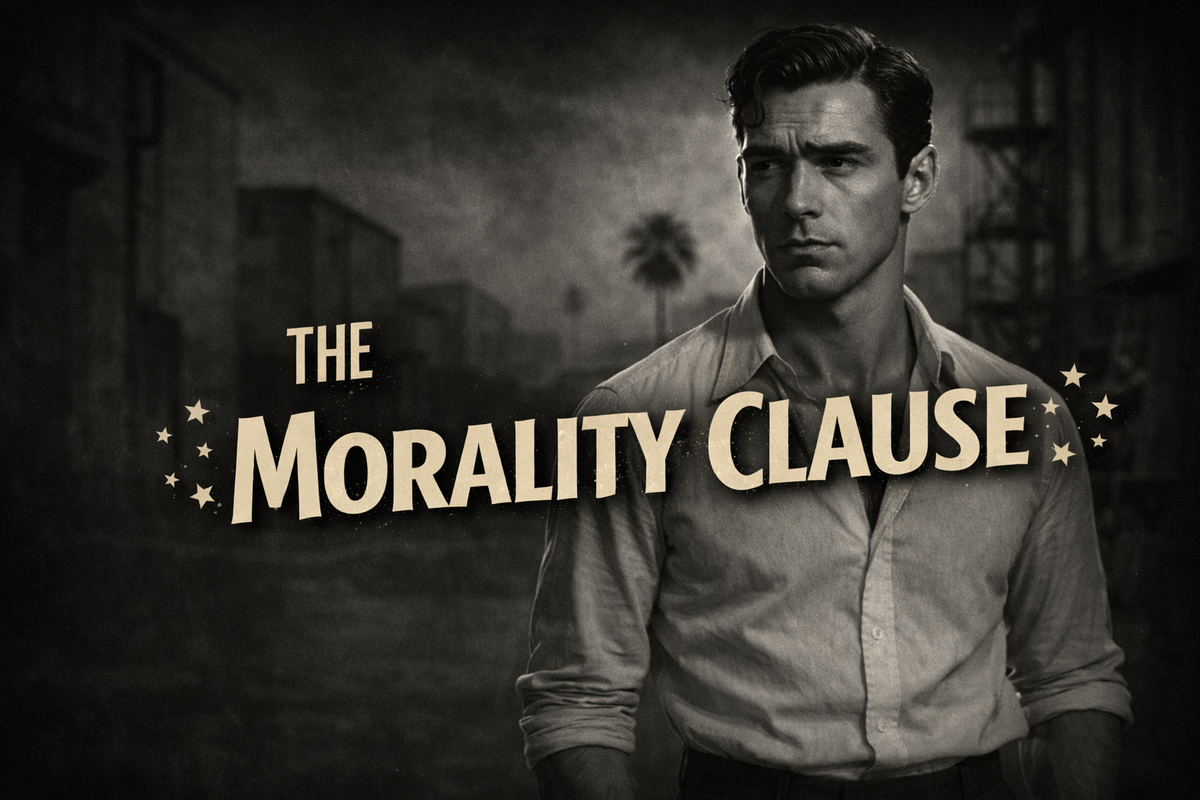
The Morality Clause

The Velvet Backlot
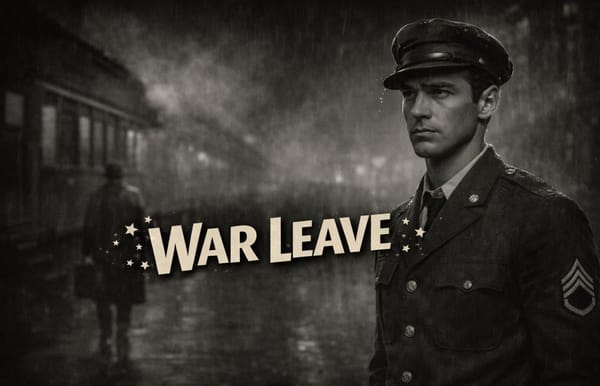
Hollywood, 1943.
Behind the glamour, contracts bind tighter than desire. Careers are constructed. Reputations are managed. And men learn quickly what parts of themselves must remain unseen.
The Velvet Backlot is a queer historical erotic series set inside the Golden Age studio system, where love exists in shadow and survival depends on performance.
The first novel, The Contract Player, follows rising actor Julian Cross and the man assigned to control him. What begins as supervision becomes proximity. What becomes proximity turns into something far more dangerous.
Desire is rationed.
Consent is negotiated.
And every choice leaves a mark.
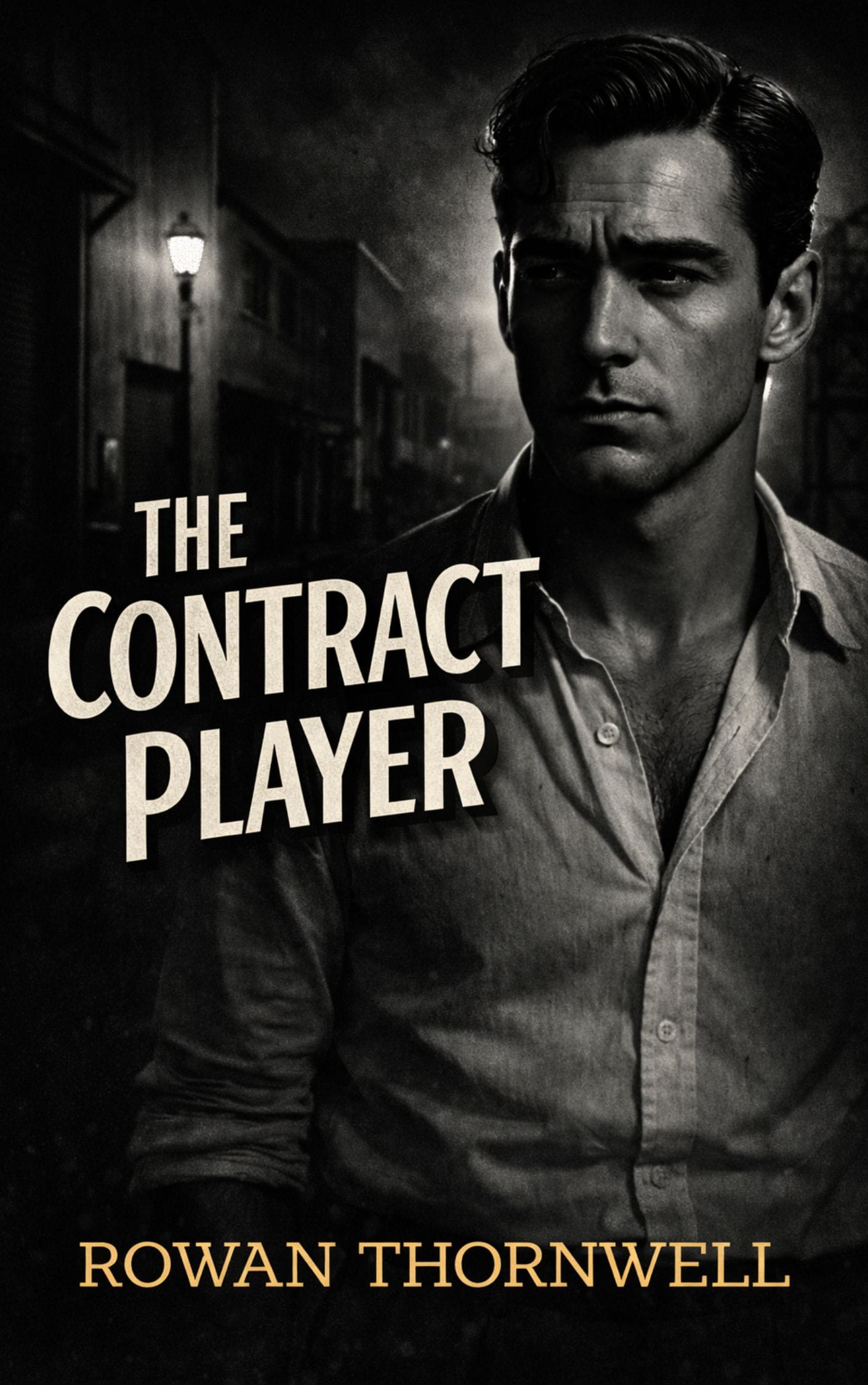
🖤 Subscribe to read The Contract Player in full.
Or purchase the complete novel directly from Rowan and own the story now.

Read Chapter One Here...
 Rowan Thornwell
The Morality Clause
Chapter Two
The telegram arrived on a Thursday, three weeks after the screen test. Julian had almost stopped checking his mailbox with any expectation. He'd taken a job washing dishes at a diner on Sunset, working the dinner shift until his hands pruned and his back ached. The telegram was wedged between an overdue rent notice and a flyer for dance lessons.
STUDIO REQUESTS YOUR PRESENCE STOP MONDAY 9AM BUILDING A STOP BRING IDENTIFICATION STOP CONGRATULATIONS STOP
He read it four times standing in the hallway, still wearing his apron, smelling of fryer grease and desperation.
Congratulations for what, exactly, it didn't say.
Building A turned out to be the administrative heart of the studio. Marble floors, brass fixtures, oil paintings of stern men in gilded frames. A receptionist with Victory curls and crimson nails directed him to the third floor without looking up from her typewriter. The elevator operator, an elderly Negro man in pristine white gloves, smiled kindly but said nothing during the slow ascent.
The hallway on the third floor stretched impossibly long, lined with frosted glass doors bearing names in gold leaf. Legal Affairs. Talent Relations. Contract Management. Julian walked slowly, aware of his shoes clicking too loudly, aware of his second-hand suit, aware that he didn't belong in rooms where decisions were made about other people's lives.
Room 307. The door was already open.
"Mr. Cross, punctual as promised. Come in, come in."
The man behind the desk was perhaps fifty, built like a retired boxer gone soft around the middle. His suit was expensive. Real wool, tailored to accommodate his bulk. Wire-rimmed spectacles perched on a broad nose. He rose, extended a hand across a desk covered in neat stacks of paper.
"Arthur Brennan. Head of talent contracts. Please, sit."
Julian sat in a leather chair that sighed beneath his weight. The office smelled of cigars and lemon oil. Behind Brennan, floor-to-ceiling windows overlooked the backlot. Soundstages and false storefronts, a painted sky rolled up like a carpet against one building.
"Coffee? Water?"
"No, thank you."
"Sensible. Never accept a drink before negotiations." Brennan smiled, though his eyes remained calculating. "Though I suppose this isn't much of a negotiation, is it? You want what we're offering. We want you to want it. That's the dance."
Julian said nothing.
"You made quite an impression," Brennan continued, settling back into his chair with a creak of leather. "Harold Levy speaks very highly of your screen test. 'Raw,' he said. 'Unpolished but genuine.' Those are valuable qualities, Mr. Cross. Audiences are tired of manufactured charm. They want something that feels real, even when it isn't."
"I'm glad he was pleased."
"More than pleased. Interested. And when Harold's interested, the studio listens." Brennan pulled a document from one of the stacks, centred it on the desk between them. "Which brings us to why you're here. We'd like to offer you a contract."
The words hung in the air, too large and strange to feel real. Julian stared at the paper. Dense paragraphs of text, clauses and subclauses, signatures required at the bottom in triplicate.
"It's a standard seven-year agreement," Brennan explained, turning the document so Julian could read it. "Starts you at seventy-five dollars a week. Not a fortune, but more than you're making washing dishes, I'd wager."
Julian's face must have betrayed surprise, because Brennan chuckled.
"We do our homework, son. After three months, assuming your work is satisfactory, that increases to one hundred weekly. After a year, one-fifty. The numbers climb from there, provided you fulfill your obligations. By year five, if you've become the star we believe you can be, you'll be looking at five hundred a week. Possibly more."
Five hundred dollars. Julian had never held that much money at once in his life.
"The studio will provide coaching—voice, diction, movement, dance if necessary. We'll arrange appropriate housing, transportation to and from the lot. We'll handle your publicity, your wardrobe for public appearances, your social calendar. You'll be given roles in at least four pictures annually, with the potential for more should the need arise. In essence, Mr. Cross, we will build you into something remarkable."
"And in exchange?"
"In exchange, you belong to us." Brennan said it lightly, almost apologetically. "Your time, your image, your career. Standard exclusivity. You work only for this studio. You appear only in our films. You attend only the events we approve. You're an investment, you understand. A considerable one. We protect our investments."
Julian nodded slowly. It sounded reasonable. It sounded like every contract he'd ever heard about. It sounded like a cage built from opportunity.
"There are, of course, certain... stipulations." Brennan pulled another document from a different stack, this one shorter. "The morality clause. I'm sure you've heard of such things."
"I've heard the term."
"Then you understand the basic principle. The studio has a reputation to maintain. Our actors are not merely employees—they're public figures, ambassadors of a sort. What they do reflects on us. Therefore, we must ensure their behaviour meets certain standards."
Brennan slid the paper across. Julian picked it up, read:
The Artist agrees to conduct himself with due regard to public conventions and morals, and agrees that he will not do or commit any act or thing that will tend to degrade him in society or bring him into public hatred, contempt, scorn or ridicule, or that will tend to shock, insult or offend the community or ridicule public morals or decency, or prejudice the Producer or the motion picture industry in general.
The language was baroque, almost Biblical in its severity. Julian read it twice, feeling something tighten in his chest.
"It's comprehensive," Brennan acknowledged. "Necessarily so. We've had... incidents in the past. Scandals that cost the studio millions, damaged careers irreparably. A drunk driving arrest. An affair with a married woman. Gambling debts. We can't afford such publicity, Mr. Cross. Neither can you."
"I don't drink much. I don't gamble. I'm not married."
"Excellent. Then this should pose no difficulty." Brennan leaned forward, folding his hands on the desk. "The clause exists to protect you as much as us, you understand. Hollywood can be a treacherous place for a young man. Temptations everywhere. People eager to exploit you, to sell stories about you, to drag you into situations that could destroy everything you're working toward. We're offering guidance. Structure. Safety."
The word safety landed with peculiar weight.
"What kind of situations?" Julian asked.
"Oh, the usual pitfalls. Associating with unsavoury individuals. Frequenting inappropriate establishments. Being seen in compromising positions." Brennan paused, adjusted his spectacles. "Certain... personal inclinations that might be misconstrued by the press or public."
The room felt suddenly smaller, airless. Julian kept his expression neutral, kept his hands still in his lap.
"I'm not sure I follow."
"I think you do, Mr. Cross." Brennan's voice remained kind, almost paternal. "We're not naive. Young men have appetites. Desires. Sometimes those desires are... complicated. The studio doesn't judge. We simply manage. Discreetly."
Julian's mouth went dry. "Manage how?"
"By ensuring you're never in a position where those desires could become public knowledge. By providing appropriate outlets when necessary, in controlled environments. By assigning someone to help you navigate the more delicate aspects of your new life." Brennan smiled. "Think of it as having a very well-informed friend. Someone who understands the landscape, who can help you avoid mistakes before they happen."
"A handler."
"Such an ugly word. Let's say an advisor. A companion of sorts."
"Assigned to me."
"For your protection, yes."
Julian looked down at the contract again, at the dense paragraphs that reduced his life to property and obligation. The Artist agrees. Over and over. The Artist agrees.
"What if I refuse?" he asked quietly.
"The contract? Or the advisor?"
"Either. Both."
Brennan sat back, expression unchanging. "Then you walk out of here with our thanks for your time and our best wishes for your future. You go back to washing dishes, or whatever work you can find. You remain Julian Cross, nobody from nowhere, with a face that the camera liked for fifteen minutes three weeks ago." He paused. "Or you sign, and you become something more. Someone who matters. Someone the world watches. It's not really a choice, is it?"
It wasn't. They both knew it.
Julian picked up the fountain pen Brennan offered. It was heavy, expensive, the kind of object designed to make signatures feel important. He held it above the first line marked for his name.
"One question."
"Of course."
"The man at the screen test. Dark suit, sat apart from the others. He didn't take notes. Just watched."
Brennan smiled. "Observant. Yes, that would be Daniel Mora. He'll be your advisor. Very experienced, very discreet. You'll meet him shortly."
"He already knows about me. About my... inclinations."
"Mr. Mora is exceptionally perceptive. It's why he's good at what he does."
Julian thought about that careful gaze, that silent assessment. The feeling of being catalogued, understood, claimed before he'd even known there was something to claim.
"And if I sign this, he'll what—follow me? Monitor me?"
"He'll guide you. The distinction matters." Brennan's voice softened slightly. "Listen, son. This city destroys people like you every day. Chews them up, spits them out, forgets they existed. The studio is offering you armour. Mora is offering you a map through a minefield. Yes, there are restrictions. Yes, you surrender certain freedoms. But you survive. You thrive. You become the man you're meant to be, even if that man can only exist within carefully drawn lines."
Julian looked at the pen in his hand, at the contract beneath it, at the windows overlooking the manufactured world of the backlot. Nothing real out there. Nothing true. Just surfaces and stories, light and shadow, desire performed for money.
He signed.
Three times on the first document. Twice on the second. His signature looked smaller each time, as if the act of writing his name was making him disappear.
"Excellent." Brennan gathered the papers with brisk efficiency. "Welcome to the family, Mr. Cross. Your life begins now."
They sent him to wardrobe first. A woman named Judith with measuring tape and sharp eyes fitted him for suits. Three of them, charcoal and navy and a light grey that she said would photograph well. Then shirts, ties, shoes that actually fit. A cashmere overcoat for winter premieres. A tuxedo that made him look like someone else entirely.
"Stand straight," Judith commanded, pinning fabric at his shoulders. "You slouch. We'll fix that. And stop apologizing when I touch you. I've dressed hundreds of actors. You're not special."
But he felt special. Or felt like he was being made into something special, piece by piece, clothing him in a version of himself that the camera would love.
Publicity came next. Headshots in three different styles, a biography written by someone who'd never met him but somehow knew his favorite color (blue, apparently), his hobbies (tennis and reading, neither of which he'd ever especially enjoyed), his dream role (anything that challenged him, naturally).
"Smile bigger," the photographer commanded. "Like you've got a secret. Yes, that's it. Hold it. Don't blink. Perfect."
By the time he finished, it was nearly four o'clock. A secretary appeared, young and efficient, and guided him back to Building A, but this time to a smaller office on the second floor. No name on the door. Just a number: 214.
"Mr. Mora is expecting you," she said, and left him standing in the hallway.
Julian knocked.
"Come in."
The voice was quiet, controlled. Julian opened the door.
The office was smaller than Brennan's, almost austere. A desk, two chairs, filing cabinets along one wall. No photographs, no personal effects. The only decoration was a single painting. Something dark and abstract that might have been a landscape or might have been nothing at all.
The man from the screen test stood by the window, silhouetted against the late afternoon light. He turned as Julian entered.
"Mr. Cross. Close the door, please."
Julian obeyed.
Daniel Mora was perhaps thirty-five, perhaps forty, difficult to tell. Dark hair combed back precisely, dark suit without a wrinkle, dark eyes that missed nothing. Handsome in an understated way, the kind of face that would fade into any crowd but commanded attention in stillness. He moved with economy, no wasted motion, no excess of gesture.
"Sit."
Julian sat.
Mora took the chair behind the desk, folded his hands on its surface. For a long moment, he simply looked at Julian. Not studying, not evaluating. Just looking, as if confirming something he already knew.
"You signed," Mora said finally.
"Yes."
"Do you understand what you signed?"
"I think so."
"No. You don't. Not yet." Mora's expression didn't change. "But you will. That's my job. To make sure you understand exactly what your life is now, what it can be, and what it can never be."
"Brennan said you were an advisor."
"Brennan uses comfortable words for uncomfortable truths. I'm here to make sure you don't destroy yourself. Or the studio. Or both." Mora leaned back slightly. "Let me be clear, Mr. Cross. I know what you are. I knew within five minutes of watching you. The way you held yourself during the screen test. The way you kissed Vivienne Chandler—technically proficient, emotionally absent. The way you looked at the lighting technician when you thought no one was watching."
Julian felt blood drain from his face.
"Don't panic," Mora continued calmly. "I'm not threatening you. I'm stating facts. You're a homosexual. It's not a moral judgment. It's simply what you are. And in this city, in this industry, that fact makes you vulnerable. My job is to minimize that vulnerability."
The word hung between them. Homosexual. Julian had never heard anyone say it aloud in reference to him. Never heard it said without disgust or pity or clinical detachment. Mora said it like he might say brunette or left-handed, a simple descriptor, neither good nor bad.
"What do you want from me?" Julian asked quietly.
"Cooperation. Discretion. Trust." Mora counted them on his fingers. "You don't go anywhere I haven't approved. You don't see anyone I haven't vetted. You don't make decisions about your personal life without consulting me first. In exchange, I keep you safe. I keep you working. I keep you from becoming another cautionary tale."
"That sounds like prison."
"Prison is where you'll end up if you're careless. This is protection." Mora's voice remained steady, patient. "Do you know what happens to men like you when they're discovered? Not speculation—actual consequences. Arrest for lewd conduct. Morals charges. Prison sentences. Even if you avoid jail, your name goes on lists. You're unemployable. Radioactive. Your family learns what you are from newspaper headlines. You die broke and alone and forgotten."
Julian's hands clenched in his lap. "You're trying to scare me."
"I'm trying to make you realistic. This isn't Hollywood magic, Mr. Cross. This is survival." Mora stood, walked to the window, looked out at the lot below. "I've been doing this for seven years. I've protected fifteen different actors. Some were grateful. Some resented me. All of them are still working. Still safe. Still alive. That's what I offer. Not freedom. Not honesty. But continuity. A future."
"And what do you get?"
Mora turned, expression unreadable. "I get to be very good at a job that matters. I get to save men who would otherwise be destroyed by what they are." He paused. "And I get to make sure the studio's investments don't self-destruct."
"You make it sound noble."
"It's not. It's pragmatic." Mora returned to his desk, pulled a small leather notebook from a drawer. "We start tomorrow. Nine AM. I'll pick you up from your current residence—which you'll be leaving, by the way. The studio has arranged an apartment in West Hollywood. Nicer neighbourhood. More appropriate for your new position. You'll move this weekend."
"I haven't agreed to this."
"You signed the contract. The contract includes me. There's nothing to agree to." Mora wrote something in the notebook, closed it. "Tomorrow we'll discuss expectations, boundaries, protocols. For now, go home. Celebrate if you like. Your life as Julian Cross, free man, ends tonight. Tomorrow you become Julian Cross, studio property. Make peace with that however you need to."
Julian stood slowly, feeling unmoored, uncertain. "Is there anything else?"
Mora looked at him. Really looked, with something that might have been sympathy or might have been pity.
"Welcome to Hollywood, Mr. Cross. Try to enjoy it."
Outside, the sky had turned the distinctive gold that only existed in California, light like honey and smoke. Julian walked the lot in a daze, past soundstages and water towers, past extras in costume smoking between takes, past everything that was now supposedly his.
He thought about the contract. The clauses. The careful language that made ownership sound like opportunity.
He thought about Mora's eyes, dark and certain, offering imprisonment as salvation.
He thought about what he'd given away without fully understanding what it was.
Somewhere a bell rang, signalling the end of a day's shooting. Workers emerged from buildings, headed toward parking lots and bus stops, their day's labour complete. Julian watched them go, envying their freedom to simply leave, to go home, to be nobody special.
He touched the papers in his jacket pocket. Copies of the contract, signed and sealed.
His life began now, Brennan had said.
But Julian wondered if something else had ended instead.
Ready to Step Behind the Curtain?
You’ve seen the lights.
You’ve felt the tension.
You know what waits in the shadows.
Binge the entire story now at FleshPrint, Rowan Thornwell’s personal author store.
No edits. No interruptions. No censorship.
Just the full, uncut first part of The Velvet Backlot exactly as it was meant to be read.
🖤 Enter FleshPrint and own The Contract Player today.